

Greener Marner
Eco-Ambassadors
We are acutely aware that there are decisions that can be made in school to enable our school to be more environmentally conscious. Some examples we consider are – what to do with food waste? How to reduce waste overall? How to reduce the amount of paper that we use? How can we encourage less car use, with more of our community using healthier alternatives for travel? A key part of our role is researching opportunities and then seeking to win support for new initiatives.
Marner achieves GOLD STAR accreditation 2021
TfL’s STARS schools accreditation scheme inspires young Londoners to think differently about travel and its impact on their health, wellbeing and the environment. Marner school community is proud to support this initiative. Do watch the video made and narrated by children in Year 3, who feel very passionate about improving air quality for all. The Mayor of London, Sadiq Khan, has just awarded more than £1.27million in funding to help tackle the capital’s toxic air by improving and creating green spaces. Projects include green ‘pollution barriers’ for schools that will help protect against toxic air, plus new green spaces for housing estates, community gardens to help improve mental health and wildlife habitats in parks. Greening playgrounds with climbing plants across entire walls, hedges, and wider green infrastructure can be beneficial to boosting air quality and reducing exposure to harmful emissions from busy roads. A recent report by the Air Quality Expert Group found a ‘green barrier’ between cars and pedestrians can halve the levels of pollution behind the barrier*.


Greener Marner Resources
Living Wall
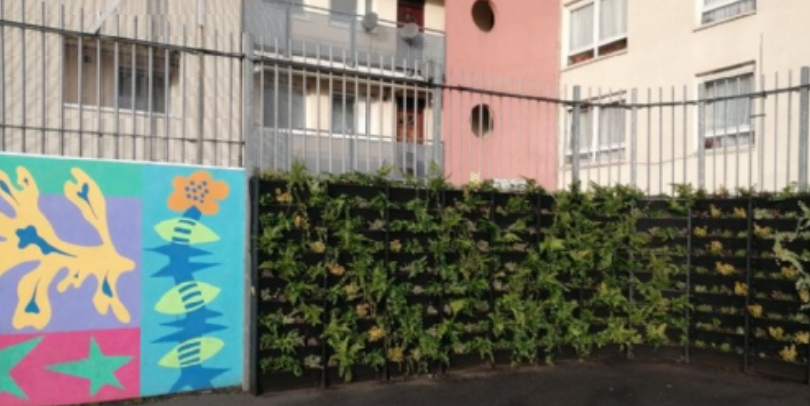
A plant box 'Living Wall' has been installed in the blue pitch. The benefits of a living wall are that they provide significant environmental and health benefits by improving air quality, increasing urban biodiversity, and offering natural insulation.
Funding was applied for by Ms Doherty through an RHS Grant (Royal Horticultural Society). The climbing plants will grow and attach to the fence. There is a range of different foliage for the children to observe and enjoy seeing them grow.
School Filters Programme
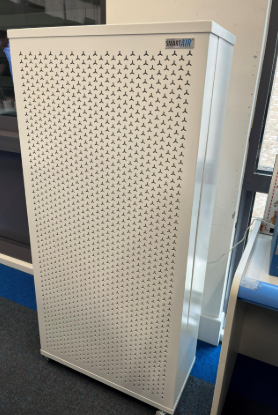
Marner has taken part this year in The Mayor of London’s School Filters Programme, which is a £2.7 million initiative to install High Efficiency Particulate Air (HEPA) filters in over 200 public primary and SEN schools. The rollout targets classrooms in areas with the highest pollution levels and deprivation to protect children from harmful particles.
The programme is delivered in partnership with environmental and engineering experts including WSP, SmartAir, and the Walk Wheel Cycle Trust.
Schools are selected based on localised air quality audits and indices of multiple deprivation, with the goal of ensuring an equitable distribution of clean air technology across all London boroughs.
A letter was received in June 2026 by the Head of Air Quality for The Greater London Authority, Poppy Lyle.
‘I’m the Head of Air Quality at the Greater London Authority and I wanted to express my sincere thanks to you and your school for your involvement in the Mayor of London’s School Filters Programme.
I especially wish to thank you for your support with the current period of close monitoring we are doing with your school, including taking calls and facilitating visits to help ensure the filters and monitors are operating correctly.
This period of close evaluation with your school is crucially important for us in getting robust data to understand how the filters are working, but I’d also like to reassure you that this period of close monitoring is nearly over! The focused evaluation period will conclude at the start of the summer holidays. After this time, monitors will still run, but only so your school can see the data if you wish to – there won’t be any need for such close attention to monitors and filters being on at the right times.
I appreciate that taking part in the evaluation may have required more staff time and coordination than originally anticipated. Apologies, I know how busy you are, and we are all incredibly grateful for the time you’ve given.
The information gathered through this monitoring period will help us understand the effectiveness of the filters. This will inform future decisions, and could help bring cleaner air to even more children across London. Early results are positive, and we look forward to sharing findings as the evaluation progresses.
We appreciate your continued support and cooperation over the final few weeks of this evaluation.
Thank you again for helping us improve air quality for children across London.
Kind regards,
Poppy Lyle (Head of Air Quality for The Greater London Authority) ‘